Wise vs Revolut Fees (2026): Which Is Actually Cheaper? 

If you’re choosing between Wise and Revolut, fees are probably your biggest concern.

Both fintech companies promise low-cost international spending and transfers — but their pricing models are very different. One focuses on transparency. The other blends banking features with subscription perks.

Here’s a clear breakdown of how their fees compare in 2026.

1. Exchange Rates: The Real Cost Difference

Wise: Mid-Market Rate + Transparent Fee

Wise uses the real mid-market exchange rate (the rate you see on Google).
Instead of marking up the rate, it charges a separate, clearly displayed fee — typically between 0.35% and 0.7%, depending on the currency.

You see the exact fee before confirming the transaction.

What this means:
You always know what you’re paying.

Revolut: Near-Interbank Rate (With Conditions)

Revolut uses a near-interbank exchange rate and offers:

  • Free weekday currency exchange (within your plan’s limit)
  • 1% markup on weekends
  • Monthly FX limits on the free plan (e.g., €1,000 equivalent)

After exceeding the monthly allowance, additional exchanges incur a fee.

What this means:
It can be very cheap — but only if you stay within limits and avoid weekends.

2. International Transfers

Wise

Fees typically include:

  • A small fixed fee
  • A percentage-based fee

For example, sending €1,000 internationally might cost between €4 and €8, depending on the currency route.

Wise is often cheaper for:

  • Larger transfers
  • Regular overseas payments
  • Sending money outside Europe

Revolut

Revolut offers:

  • Some free transfers depending on your plan
  • Possible SWIFT fees for certain currencies
  • Limits on free international payments

Revolut works well for occasional smaller transfers, but costs can increase once limits are exceeded.

3. ATM Withdrawals

Wise

  • 2 free withdrawals per month (up to ~€200 total)
  • After that: ~€0.50 + 1.75%

Revolut (Standard Plan)

  • 5 free withdrawals per month (up to ~€200)
  • Then 2% fee

Higher-tier Revolut plans increase the withdrawal allowance.


4. Card Payments Abroad

Both are excellent for travel compared to traditional banks.

  • Wise: Small conversion fee applied transparently.
  • Revolut: No weekday FX fee within limits, but weekend markup applies.

If you travel mostly during weekdays and don’t exceed limits, Revolut can be cheaper for everyday spending.

5. Monthly Fees

Wise

  • No subscription plans
  • No monthly fee
  • Pay only when you use it

Revolut

  • Standard plan: Free
  • Paid plans: Plus, Premium, Metal (monthly fee)
  • Includes perks like insurance, airport lounge access, and higher limits

If you want an all-in-one banking app with extras, Revolut’s paid tiers may justify the cost.

So Which Is Cheaper?

Choose Wise If:

  • You send large international transfers
  • You want full transparency
  • You don’t want subscription fees
  • You care about always getting the real exchange rate

Choose Revolut If:

  • You travel frequently
  • You exchange smaller amounts
  • You stay within monthly FX limits
  • You avoid weekend currency exchanges
  • You want banking features beyond transfers

Final Verdict

There’s no universal winner.

  • Wise is usually cheaper for international money transfers and large currency conversions.
  • Revolut can be cheaper for travel spending — if you stay within plan limits.

For many people, the smartest move isn’t choosing one — it’s using both.
Blackstone backs Neysa with up to $1.2 B to power India’s AI compute push 

The scoop: Neysa, an Indian AI infrastructure provider, has secured up to $1.2 billion in financing led by Blackstone as India accelerates efforts to build its own domestic AI compute capacity.

Why it matters

  • This is one of India’s largest AI infrastructure financing deals to date, underscoring global investor confidence in local compute platforms.
  • India is trying to reduce reliance on U.S. and Chinese cloud providers by building local AI compute capacity.
  • The funding will support deployment of tens of thousands of GPUs, a critical bottleneck for large-scale AI workloads.

The big picture

Blackstone’s investment combines roughly $600 million in equity with plans for an additional $600 million in debt financing for Neysa, which has historically operated with far smaller capital. The startup intends to expand GPU infrastructure — including deploying more than 20,000 GPUs over time to meet surging demand for AI training and inference.

India’s policy environment, including incentives for cloud and AI infrastructure providers, has made the market more attractive for such large-scale investments.

Between the lines

  • The deal signals a shift in AI infrastructure funding: traditional asset investors are stepping in where VCs once dominated.
  • Neysa aims to serve enterprise customers, government agencies, and AI developers needing low-latency, compliant, onshore compute rather than relying on overseas providers.
  • Competition is heating up, with other local players scaling capacity, global hyperscalers expanding into India, and regional policies favouring domestic compute growth.

What’s next

Expect to see:

  • Rapid scaling of GPU clusters in India’s major tech hubs
  • More international capital entering regional AI infrastructure
  • Policy tailwinds shaping long-term compute ecosystems

This deal could be a milestone in India’s bid to become a global AI compute hub — not just an AI services consumer.

Why does Hargreaves Lansdown have some Swedish companies and not others

1. Exchange Access & Settlement

HL offers access to “major international exchanges” (like Stockholm, Paris, Frankfurt, NYSE, Nasdaq, etc.), but they don’t automatically make all companies on those exchanges available.

  • They rely on CREST and Euroclear (the settlement systems) and need to have a smooth process for custody and dividends.
  • Smaller or less liquid Swedish stocks sometimes aren’t supported because they’re harder/expensive to settle.

2. Liquidity & Demand

HL curates what’s listed for retail clients.

  • Large caps / well-known Swedish companies (think Volvo, Ericsson, Evolution Gaming) tend to be included because they’re liquid and there’s demand.
  • Small caps or niche companies may not be available unless enough HL clients request them — not worth the admin burden otherwise.

3. Corporate Actions & Complexity

Foreign shares often involve dividend tax, rights issues, and corporate actions. HL simplifies its offering to avoid the cost/complexity of handling lots of “long tail” small companies overseas.


4. Custody Costs

HL passes some overseas custody and settlement costs onto clients in its dealing fees.
If a stock would require unusually high back-office overhead, HL may simply choose not to offer it to retail clients.


5. Regulatory / Listing Requirements

Some companies, even though they’re on the Stockholm Exchange, might trade only in certain share classes (A vs B shares, for example). HL typically lists the more liquid share class (usually the B shares in Sweden). That’s why you’ll sometimes find “Rokob” but not “Rokoa.”

Can you buy single shares of Xiaomi or do you need to buy 200 shares at a time?

It all depends on where you buy the Xiaomi stock.

Hong Kong Stock Exchange (1810.HK)

  • On the HKEX, stocks trade in “board lots” (minimum trading units).
  • For Xiaomi (1810.HK) the board lot is 200 shares.
  • That means if you buy directly in Hong Kong, you have to buy at least 200 shares (or multiples of 200).
  • Example: If Xiaomi trades at HK$15, the minimum investment is HK$3,000 (~US$380).

U.S. OTC Market (XIACF, XIACY)

  • In the U.S. OTC market, you can buy single shares (no board lot restriction).
  • So if you’re using a U.S. or international broker that gives access to OTC, you can buy 1 share, 10 shares, 37 shares — whatever you like.

How can I buy shares of Xiaomi and under what ticker symbol

Ticker Symbols & Where to Buy

1. Hong Kong Stock Exchange (Primary Listing)

  • Ticker: 1810.HK (often just “1810”)
  • That’s Xiaomi’s main public listing and the one most commonly used by investors. You’d buy this through a broker that provides access to Hong Kong markets.

2. Over-the-Counter (OTC) in the U.S.

  • Tickers: XIACF and XIACY
  • These are U.S. OTC representations (likely ADRs or Pink Sheet listings). They let U.S.-based investors access Xiaomi without needing a Hong Kong broker.

Levelsio Investment Portfolio Google Doc – ETFs and One off stock investments

Levelsio on X – has started to share a Google Doc with all his investments. Its a very interesting mix between ETFs and one off stocks.

Take a look here – levels.vc

It shows the power of VC investing over time. One third of all money he makes is from his investments.

Levels has risen to fame through the X platform where is creating a lot of content and been posting about technology, finance, startups, etc.

Revolut is now Lithuania’s largest bank, after only five years


Revolut has achieved a remarkable milestone: it is now the largest bank in Lithuania by assets, just five years after securing its license there. According to the central bank, Revolut now commands 30.8% of the Lithuanian market, overtaking long-time leaders Swedbank (24.4%), SEB (19.6%), Luminor (10.5%) and the recently rebranded Artea (6.6%).

Licensed in Lithuania but serving 50 million customers across 30 EEA countries, Revolut has rapidly grown its local footprint with more than 650,000 Lithuanian clients. In 2024 alone, retail customers grew 24%, business clients 57%, and youth accounts 47%. This year, Revolut also entered the housing loan market, further cementing its presence alongside its full suite of digital banking, credit, investment, and savings products.

Intel gets new shareholders – Softbank and the US Government

SoftBank has invested $2 billion in Intel.

SoftBank Group Chairman and CEO Masayoshi Son said in a statement that the “strategic investment reflects our belief that advanced semiconductor manufacturing and supply will further expand in the United States, with Intel playing a critical role.”

This is mixed with the US Government also announcing that they will take a 10% stake in Intel.

Bunq – Dutch online bank – fined €2.6 million by Regulators for anti-money laundering controls

  • Fine imposed: Bunq, the Dutch mobile-only bank, was slapped with a €2.6 million fine (about $3.04 million) by the Dutch central bank, De Nederlandsche Bank (DNB).
  • Why: The regulator found serious flaws in Bunq’s anti–money laundering (AML) systems. Between January 2021 and May 2022, in four separate cases, Bunq failed to properly investigate and report suspicious financial activity.
  • Repeat issue: These weren’t isolated mistakes—DNB noted that Bunq had a history of similar compliance lapses and hadn’t addressed them adequately, even after previous fines and warnings.

Bunq’s response

  • Bunq disagrees with the ruling and has formally filed an objection.
  • They emphasized that they take their “gatekeeper” role seriously and are using advanced tech to continuously improve their systems and compliance.

via Reuters.

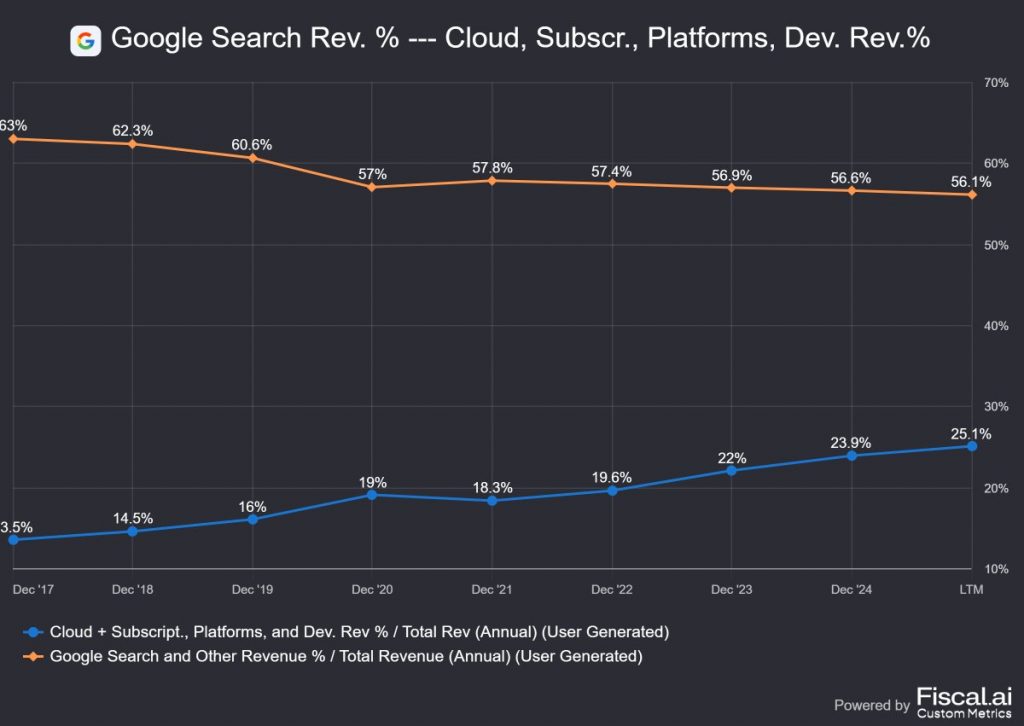
Google Search revenues becoming smaller as a percentage of total Google revenues – cloud, subscriptions and YouTube rising fast!

Alphabet’s revenues are become more diverse over time – and quickly!

Google Search revenues now make up only 56.1% of their total revenues and the gap is getting smaller every quarter.

Google Cloud is driving growth in the other areas, but YouTube is also climbing fast as well as other subscriptions and devices (and lets not even talk about Waymo and its potential).

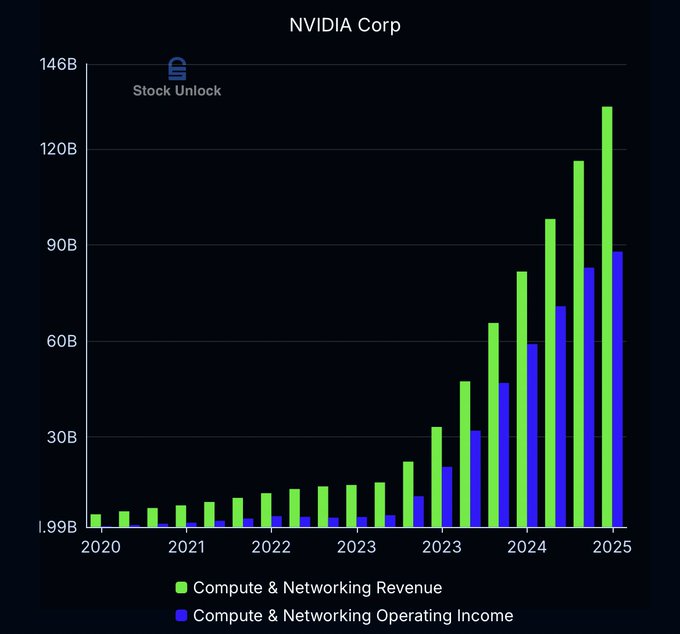
Nvidia Reports Earnings next week – where is this chart headed?

Nvidia earnings are reported next week. It will be very interesting to see how this chart continues to move over the coming quarters and years. I think it is all going higher, but I think we are starting to see a little bit of a slower growth, which hopefully will allow them some breathing space to stabilise a few things.

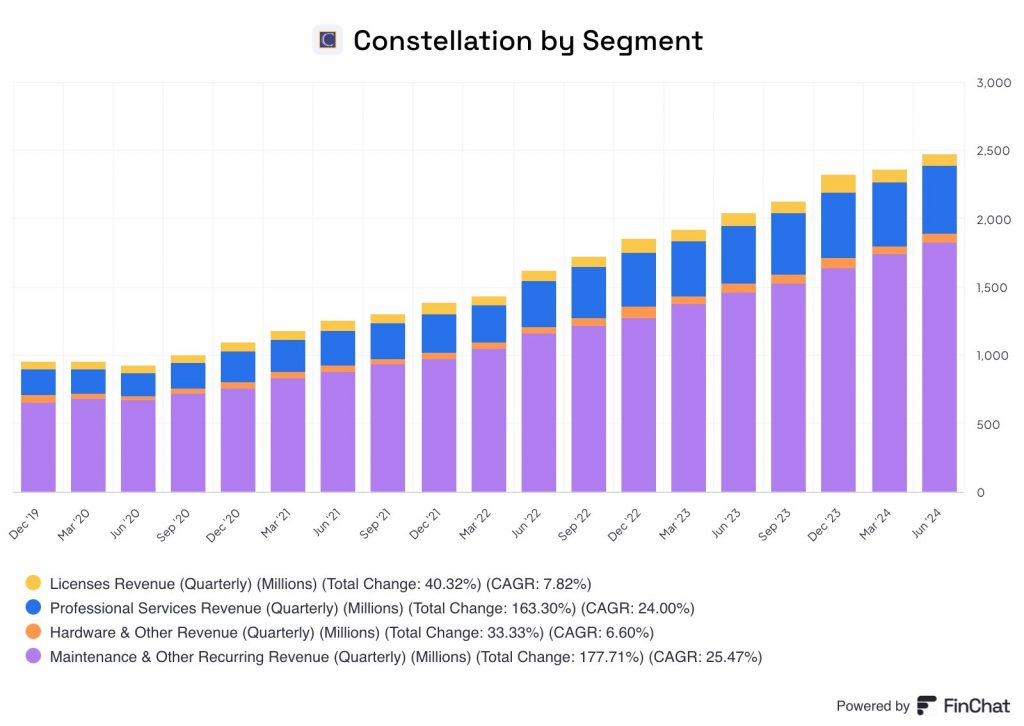
Constellation Software Revenue by Segment – 2019 – 2024

I came across this amazing chart of the growth of Constellation Software and their revenue by Segment.

As you can see Constellation has been on an amazing growth story since the very beginning and it doesn’t look like it is going to slow down any time soon.

I just wish I could invest in them from the UK, but no broker is really offer an option to buy their stock! If they had this I’m sure it would go even higher faster!

TSMC (TSM) Release Their Q2 2024 Earnings. Strong Results Above Expectations, but Drop in Stock Price

TSMC has just released their Q2 2024 Earnings.

EPS: $1.48 vs $1.39 estimate

Revenue: $20.82 billion vs $20.06 billion estimate

Gross margin for the quarter was 53.2%, operating margin was 42.5%, and net profit margin was 36.8%. For Q3 2024 TSMC expect revenue between $22.4-$23.2 billion. The middle is well above the estimate of $22.65 billion.

This seems like another good quarter for TSMC overall, but so far the market has pushed down the share price and now it is trading at a forward P/E of 23

Time to buy??

Amit Interviews Robinhood CEO and Co-Founder, Vlad Tenev. Robinhood Gold Economics and more.

The other day I just came across Amit on YouTube and noticed that he sat down and interviewed Robinhood CEO and Co-Founder, Vlad Tenev.

It’s a great interview and really worth the watch.

My favourite part is them talking about the new Robinhood Gold and the economics behind the product.