DistroKid’s Pricing Structure and How It Doesn’t Align with Independent Artists

DistroKid is a popular music distribution service that allows independent artists to release their music on various online platforms like Spotify, Apple Music, and more. However, many artists have expressed frustration with DistroKid’s pricing structure and how it doesn’t align with the needs of independent artists.

DistroKid’s pricing structure is based on a yearly subscription fee, which ranges from $19.99 to $79.99 per year, depending on the plan chosen. While this may seem reasonable at first glance, it becomes problematic for artists who release a lot of music. For instance, an artist who releases a single every month would have to pay $239.88 per year just to distribute their music. This cost doesn’t include additional fees for services like YouTube monetization or Shazam verification.

Moreover, DistroKid charges an additional fee for each release an artist makes. While the first release is included in the subscription fee, subsequent releases cost $4.95 each. For artists who release multiple singles or albums per year, this can quickly add up and become a significant financial burden.

Another issue with DistroKid’s pricing structure is that it doesn’t offer any flexibility for artists. For instance, an artist who releases only one or two songs per year still has to pay the same subscription fee as an artist who releases multiple albums. This lack of flexibility makes the service less accessible to independent artists who are just starting their careers and may not have a lot of income.

Furthermore, DistroKid’s pricing structure doesn’t align with the revenue streams that independent artists rely on. For instance, streaming services like Spotify pay artists based on the number of streams their music receives. However, DistroKid’s pricing structure is based on a fixed subscription fee, which means that independent artists may not be able to recoup their costs if their music doesn’t receive a lot of streams.

In conclusion, DistroKid’s pricing structure doesn’t align with the needs and realities of independent artists. While the service may be useful for some artists, it can quickly become a financial burden for those who release a lot of music or who are just starting their careers. Independent artists should explore other distribution services that offer more flexibility and better align with their revenue streams.

The Top 10 Generative AI Projects at the Moment

Generative Artificial Intelligence (AI) is a field of machine learning that involves creating machines and algorithms that can produce new and original content. From art and music to literature and video games, generative AI is changing the way we think about creativity. Here are the top 10 generative AI projects that are pushing the boundaries of what’s possible:

  1. GANs for Art: Generative Adversarial Networks (GANs) are one of the most popular types of generative AI algorithms. They work by pitting two neural networks against each other. One network generates new content, while the other network tries to determine if the content is real or fake. Artists are using GANs to create realistic portraits, landscapes, and other types of art.
  2. OpenAI’s GPT-3: GPT-3 is the latest natural language processing model developed by OpenAI. It can generate human-like text, translate languages, and even answer complicated questions. With over 175 billion parameters, GPT-3 is one of the most advanced AI models in existence.
  3. Magenta: Magenta is a Google project that uses machine learning to create music and art. It includes a variety of tools for musicians and artists, including a neural network that can generate new melodies and harmonies.
  4. AI Dungeon: AI Dungeon is a text-based adventure game that uses GPT-3 to generate new storylines and characters. Players can input their own prompts and watch as the AI generates an entirely new adventure.
  5. GANs for Fashion: GANs are also being used in the fashion industry to create new designs and styles. Designers can input different parameters, such as fabric and color, and watch as the GAN generates new clothing items.
  6. GANs for Video Games: GANs are being used to generate new video game levels and characters. By inputting different parameters, game designers can create entirely new worlds and experiences.
  7. DeepDream: DeepDream is a Google project that uses neural networks to generate psychedelic and surreal images. Users can input their own images, and the AI will generate new, dream-like versions of them.
  8. Generative.fm: Generative.fm is a website that uses AI to generate ambient music in real-time. Users can customize the music by adjusting different parameters, such as tempo and mood.
  9. GANs for Medical Imaging: GANs are being used to generate realistic medical images, which can be used for training medical professionals and developing new treatments.
  10. GANs for Architecture: GANs are also being used in the architecture industry to generate new building designs and layouts. By inputting different parameters, architects can create entirely new buildings and structures.

As generative AI continues to advance, we can expect to see even more exciting projects and applications in the coming years. From art and music to medicine and architecture, the possibilities are endless.

Apple’s Cash Reserves: How Much Do They Really Have?

Apple Inc. is one of the largest and most successful technology companies in the world. The company is known for its innovative products, including the iPhone, iPad, and Mac, which have revolutionized the way we communicate and work. However, one of the most interesting aspects of Apple’s success is its cash reserves.

As of the end of the second quarter of 2021, Apple had a staggering $193.8 billion in cash reserves. This is a mind-boggling amount of money, and it’s hard to imagine just how much it really is. To put this in perspective, this is enough money to buy roughly 3,876,000 Tesla Model S Plaid cars, or to pay the yearly tuition fees of over 2.6 million Harvard students.

So, why does Apple have so much cash? Well, there are a number of reasons. First, Apple is an incredibly profitable company. In the second quarter of 2021 alone, the company generated $89.6 billion in revenue, with a net income of $23.6 billion. This level of profitability allows Apple to generate significant amounts of cash each quarter.

Second, Apple has a history of being very conservative with its spending. The company is known for being very disciplined when it comes to investing and spending money. This means that Apple has historically been able to generate significant amounts of free cash flow, which it can then use to build up its cash reserves.

Finally, Apple has also historically used its cash to invest in research and development, as well as to acquire other companies. This strategy has allowed Apple to stay at the cutting edge of technology and to continue to produce innovative products that consumers love.

In conclusion, Apple’s cash reserves are truly staggering, and they are a testament to the company’s incredible success and profitability. While some may argue that Apple should do more with its cash, there is no doubt that the company’s conservative approach to spending has helped it to build up a truly impressive war chest.

How do I Add or Remove Songs from RouteNote?

Adding Songs to RouteNote

To add your songs to RouteNote, you first need to create an account on their website. Once you have an account, you can log in and go to the dashboard. From there, you will see an option to “Create New Release.” Click on that and fill in the necessary details like the album or single name, artist name, and release date. Then, you can upload your music files and artwork. After that, you will need to select the streaming services you want your music to be distributed to. RouteNote offers both free and paid options, so choose the one that suits your needs. Once you have completed all the steps, RouteNote will review your release, and if everything is in order, they will distribute your music to the selected services.

Removing Songs from RouteNote

If you want to remove your songs from RouteNote, you can do so by going to your dashboard and selecting the option to contact the support team. The support team will do all the heavy lifting and you simply need to email them and ask them to remove the releases in question.

Spotify / Findaway – Dropping Its Cut on Audiobook Fees

Findaway, an audiobook seller owned by Spotify, has announced that it will no longer take a 20 percent cut of royalties for titles sold on its DIY Voices platform if the sales are made on Spotify. In a blog post published on Monday, Findaway stated that it would “pass on cost-saving efficiencies” from its integration with the streaming service. Last summer, Spotify finalized its $123 million acquisition of Findaway in a move to solidify its position in the audiobooks business.

While authors can upload their audiobooks onto Findaway’s Voices platform for free, the company normally uses an 80/20 pricing structure where Findaway takes a 20 percent fee on all royalties earned. However, that fee is applied after sales platforms take their own 50 percent cut on the list price. Under the old revenue split, an author who sold a $10 audiobook would have to give $5 to Spotify and $1 to Findaway. But moving forward, that same author will no longer have to pay the $1 distribution fee to Findaway when a sale is made through Spotify.

The Best 5 Free Investing Tools in 2023

Morningstar:

Morningstar is an American financial services firm. It provides an array of investment research and investment management services. You can take a look at a company’s financials, valuation, operating performance, dividend, ownership and much more.

Dataroma:

This site allows you to track the portfolios of the best investors in the world. Think about Warren Buffett and Terry Smith. You can also take a look at which stocks are bought the most by these superinvestors, which insiders are buying their own stocks.

Yahoo Finance:

Yahoo Finance provides you with financial news, data and commentary including stock quotes, press releases, financial reports, and original content. It’s a great website to check daily stock news or create a watchlist.

Seeking Alpha:

If you are looking for stock analysis, Seeking Alpha is the place to be. You can follow the stocks you want and you’ll receive an email each time someone publishes an article about the companies you’re interested in.

You can follow the stocks you want and you’ll receive an email each time someone publishes an article about the companies you’re interested in.

Investopedia:

If you want to learn about a certain investment topic, Investopedia is the place to be. It features articles, tutorials, videos, and other content designed to help individuals make informed financial decisions.

It features articles, tutorials, videos, and other content designed to help individuals make informed financial decisions.

Financials and Multiples on the Believe Digital and Sentric Music Publishing Deal

This morning we posted about Believe Digital acquiring Sentric Music Publishing.

I wanted to provide a little more context about the acquisition.

Sentric – Companies House accounts – https://find-and-update.company-information.service.gov.uk/company/05721428/filing-history

2021 Year End Numbers:

  • £29.5m Revenue (up 57% YOY)
  • £24.2m COGS
  • £4.8m GP (8.5x multiple to value)
  • £1.2m NP (34x multiple to value)

Acquisition price was $51 million.

It feels like this was a good price on both counts. Utopia obviously sold Sentric at a discount, but they really need to get rid of the asset (they only purchased a year ago). Believe got a good asset in a new market – at a reasonable multiple.

Believe Digital Acquires Sentric Music Publishing from Utopia Music for $51 million

Believe Digital has acquired music publishing company Sentric for $51 million from Utopia Music.

This is a great move from Believe – and as Utopia have been in a lot of issues with debt recently – it feels like a bit of a fire sale.

“The acquisition of SENTRIC is the first step for BELIEVE in the roll-out of a global and comprehensive publishing offer. The growth and digital transformation of the songwriters’ market is opening-up many opportunities. We are excited to be able to immediately expand the services we provide to our existing TUNECORE clients with SENTRIC’s best-in-class royalty collection service, while starting to work on future innovative products and services for all of Believe’s songwriters and publishers.”

BELIEVE CEO DENIS LADEGAILLERIE said,

Believe is currently looking for more acquisitions – they normally focus around record labels, but this put Believe into a completely new market with a strong TAM.

Banking Sector is Ready for Even More Innovation and Opportunities

A lot of people are talking about Banks at present with the recent collapse of Silicon Valley Bank and others.

The banking sector is always an interesting topic and they are actually very interesting businesses.

They are in the business of using other people’s money to generate more money and try to add value through different services. If everyone takes their money out of a bank all at the same time – then all the banks in the world don’t have enough reserves to cover this.

However, with the death of the local branch – it seems now there is a growing opportunity for banks to slim down their staffing requirements, capital expenditures and simply products and services to focus on value driven opportunities.

It will be interesting in the coming months if there are any more banking collapses, but its an industry that is going to be heavily upset by the new online only banks focused on a much wider variety of services – at a fraction of the high street bank prices.

Duolingo Working on a Music App – Music Industry Watch This Space!

Duolingo is currently working on a music app.

It turns out that Duolingo (which has over 500 million users – not sure how many are active) – have been working on a music app with a small team for some time.

There is currently a job for a learning scientist who is an “expert in music education who combines both theoretical knowledge of relevant learning science research and hands-on teaching experience”.

The job listing suggests that the app will teach basic concepts in music theory using popular songs and teachers.

This sounds very interest – as it would be a great stepping stone for Duolingo to move into a lot of new and interesting areas of education, with their already massive audience.

via – Techcrunch

Deel 2022 ARR (Annual Recurring Revenue) Reaches $295 million

Deel is an amazing HR tool that focuses on global payroll and compliance systems.

In 2021 Deel had $50 million in ARR

In 2022 Deel has just announced they had $295 million in ARR (annual recurring revenue).

This also coincides with Deel announcing that they are now at a $12 billion valuation.

In this past 12 months Deel has announced the launch of Deel HR, US Payroll, and Deel Engage, applications for hiring, managing and paying global workers compliantly.

Deel is going to be a company to watch in the HR space for many years to come and if they are going to be acquired they really need be acquired within the next 24 months – otherwise they are going to be too big!

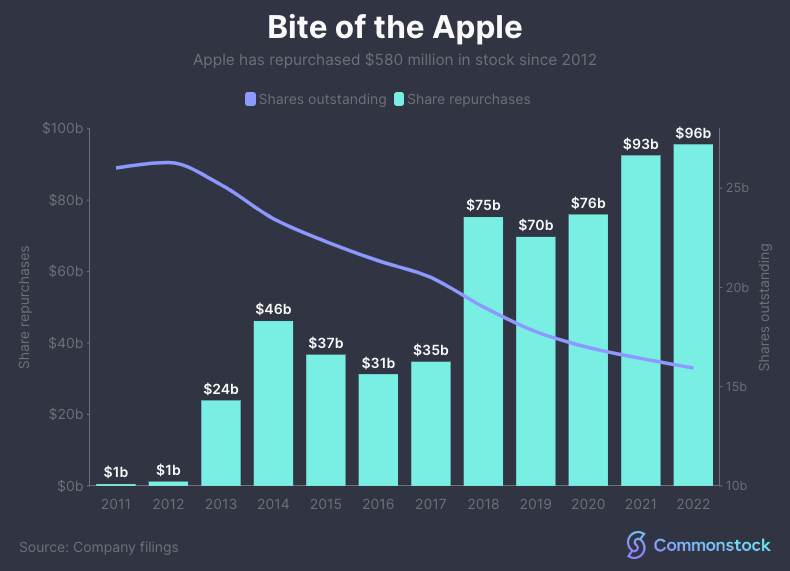
Apple Share Buybacks Since 2012 – $580 billion

via Commonstock

Since 2012, when Apple’s share count peaked, the company have repurchased more than $580 billion in stock.

That’s ~38% of the outstanding share count in ten years.

Even if the revenues remained flat the share price would increase and you would be far better off purely for holding.

Warren Buffett and Berkshire Hathaway hold a huge number of Apple stock – they must be laughing!

What is Free Cash Flow (FCF) – Definition and Example

Free cash flow (FCF) is a financial metric that measures a company’s ability to generate cash after accounting for capital expenditures. It is an important indicator of a company’s financial health and ability to pay dividends, make acquisitions, and invest in growth opportunities.

FCF is calculated by taking a company’s operating cash flow (OCF) and subtracting capital expenditures (CapEx). OCF is the cash generated from a company’s operations, while CapEx is the cash spent on investments in property, plant, and equipment (PPE).

For example, if a company has an OCF of $100 million and CapEx of $50 million, its FCF would be $50 million. This means the company has $50 million in cash left over after accounting for investments in PPE.

A positive FCF is considered to be a good sign, as it means a company is generating more cash than it’s using in its operations. It also indicates that a company has a strong financial position and is able to pay dividends, make acquisitions, and invest in growth opportunities. On the other hand, a negative FCF is considered to be a red flag, as it means a company is using more cash than it’s generating, and it may indicate financial difficulties.

It’s important to note that FCF is different from net income, which is a measure of a company’s profitability. Net income takes into account a variety of factors such as revenue, expenses, and taxes, while FCF only measures cash flow. Additionally, FCF can also be affected by a company’s accounting methods and may not always reflect the true cash position of the company.

In summary, Free Cash Flow (FCF) is a financial metric that measures a company’s ability to generate cash after accounting for capital expenditures. It is an important indicator of a company’s financial health and ability to pay dividends, make acquisitions, and invest in growth opportunities. Positive FCF is considered to be a good sign, while negative FCF is considered to be a red flag, it’s important to consider it along with other financial metrics and market conditions.

Quick Snowflake Company Overview, Its Current Free Cash Flow (FCF) Position and Why It’s Important

Snowflake is a cloud-based data warehousing company that allows businesses to store, analyze, and share data in real-time. The company’s platform is built on top of the cloud infrastructure provided by Amazon Web Services, Microsoft Azure, and Google Cloud Platform. Snowflake is publicly traded on the New York Stock Exchange under the ticker symbol SNOW.

One important metric for evaluating a company’s financial health is free cash flow (FCF), which is the amount of cash a company generates after accounting for capital expenditures. FCF is important because it shows a company’s ability to generate cash and pay dividends or make acquisitions.

Snowflake has a positive free cash flow position, meaning that it generates more cash than it uses in its operations. In the most recent quarter, Snowflake reported a FCF of $56.6 million, up from $20.2 million in the same quarter last year. This represents a 180% year-over-year growth in FCF.

This strong FCF position has allowed Snowflake to invest in growth initiatives, including expanding its sales and marketing efforts and research and development. The company has also been able to return cash to shareholders through share buybacks.

Snowflake’s financial position has been supported by its subscription-based business model, which provides a steady stream of recurring revenue, and the growing demand for cloud-based data warehousing solutions. The company has also benefited from the shift to remote work and digital transformation as more companies turn to Snowflake’s cloud-based data warehousing solutions.

Quick Veeva Systems Company Overview, Its Current Free Cash Flow (FCF) Position and Why It’s Important

Veeva Systems is a cloud-based software company that specializes in providing solutions for the pharmaceutical and biotechnology industries. The company’s product portfolio includes solutions for customer relationship management, clinical trial management, and regulatory compliance. Veeva is publicly traded on the New York Stock Exchange under the ticker symbol VEEV.

One important metric for evaluating a company’s financial health is free cash flow (FCF), which is the amount of cash a company generates after accounting for capital expenditures. FCF is important because it shows a company’s ability to generate cash and pay dividends or make acquisitions.

Veeva Systems has a strong free cash flow position. In the most recent quarter, Veeva reported a FCF of $284.5 million, up from $221.1 million in the same quarter last year. This represents a 28.5% year-over-year growth in FCF.

This strong FCF position has allowed Veeva to make strategic acquisitions and return cash to shareholders through share buybacks and dividend payments. The company has also been able to invest in research and development and expand its product offerings.

Veeva’s financial position has been supported by its subscription-based business model, which provides a steady stream of recurring revenue. The company has also benefited from the growing demand for cloud-based solutions in the pharmaceutical and biotechnology industries.

Zoho Has a Strong Product Portfolio – but No Plans to Go Public Just Yet

Zoho is a privately held software development company that offers a wide range of products for businesses of all sizes. The company was founded in 1996 in India, and it has since grown to become a major player in the software industry.

One of the most notable aspects of Zoho is its extensive product portfolio, which includes solutions for various business functions such as customer relationship management, accounting, human resources, and more. Some of their popular products are CRM, Mail, Office Suite, Creator, and Books.

Zoho CRM, for example, is a comprehensive CRM solution that helps businesses manage their sales, marketing, and customer support activities. Zoho Mail, on the other hand, is a web-based email service that offers a range of features such as calendar, contacts, and tasks.

In addition to its diverse product offering, Zoho is also known for its commitment to customer service and support. The company offers a wide range of resources, including documentation, tutorials, and webinars, to help customers make the most of its products.

Despite its success, Zoho has no plans to go public. According to the CEO, Sridhar Vembu, the company is focused on building a sustainable business model, rather than chasing short-term gains. He believes that going public would pressure the company to focus on meeting quarterly earnings targets, rather than long-term growth.

However, it’s worth noting that this doesn’t mean that Zoho will never go public. The company could change its mind in the future if it feels that going public would be in the best interest of its shareholders.